

Cybersecurity offers a potential career path for Americans interested in technology, but perceptions about qualifications and experience may discourage people from pursuing opportunities. Workers considering a career change must weigh their existing skills against what they believe employers expect. A questionnaire conducted on behalf of Southern Utah University (SUU) surveyed 577 U.S. adults to explore how Americans view cybersecurity careers, what prevents them from entering the field and what could motivate them to make the switch.
Americans who have never worked in cybersecurity, the 545 respondents asked about barriers and training, are the people most likely to be weighing a switch, so their answers show which requirements they believe stand in the way. Formal training is one response, and SUU offers an online M.S. in Cybersecurity with Information Assurance for people who want that credential.
Quick Highlights
A career changer weighing cybersecurity is deciding on pay, qualifications and job security; these five findings show how Americans see each.
-
-
- Americans think an entry-level cybersecurity job pays $75,885 a year on average.
- 38% of Americans who have never worked in cybersecurity have skipped applying for a cyber job because they felt underqualified.
- 59% of Americans without a college degree say not having one would make starting a cybersecurity career very or extremely hard.
- 39% of Americans outside cybersecurity would take a pay cut to break into the field, and 53% of them expect their pay to catch up in less than two years.
- Nearly seven in 10 Americans say AI-proof careers are a top priority when considering cybersecurity jobs.
-
How Americans Perceive Cybersecurity Careers and Qualifications
Entering a new profession often begins with understanding what employers expect and whether personal experience aligns with those expectations. For prospective cybersecurity professionals, perceptions of education, age and professional background can influence whether they consider the field a realistic option.
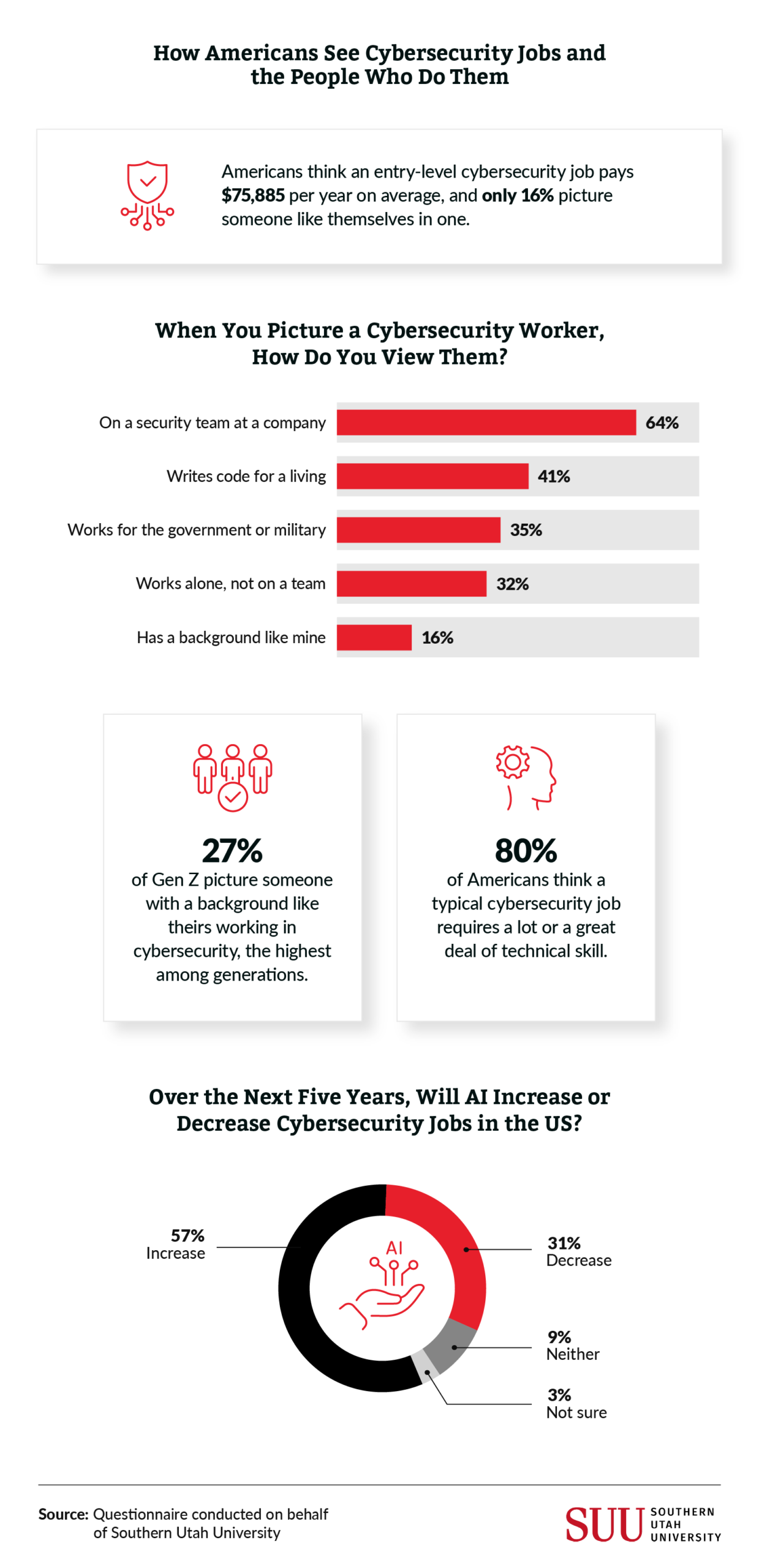
Americans estimated that an entry-level cybersecurity job paid an average annual salary of $75,885. Age was a concern for a smaller group. Nearly one in five (19 percent) agreed that there was an age when it became too late to start a cybersecurity career, placing that cutoff at 46 years old on average.
When asked which qualifications employers accepted for entry-level cybersecurity positions, respondents most frequently identified a bachelor’s degree (67 percent) and an industry certification (61 percent). Just over one in four (26 percent) selected an associate degree, and a quarter (25 percent) selected a master’s degree or higher. Only 14 percent thought skills and experience alone, without a formal credential, were sufficient, while five percent were unsure. Most respondents, in other words, expected a formal credential; for the 60 percent who already hold a bachelor’s degree or higher, graduate study is one way to add another.
Perceptions of belonging also differed across generations. Gen Z respondents were most likely to picture someone with a background similar to theirs working in cybersecurity (27 percent), followed by millennials (17 percent), Gen X (11 percent) and baby boomers (six percent). A cutoff like the 46-year average matters most to career changers near that age, who may rule out the field before checking what employers actually require.
Why Americans Hesitate to Apply for Cybersecurity Jobs
Career transitions can feel difficult when job requirements appear to exceed a candidate’s existing qualifications. Even people interested in cybersecurity may hesitate to pursue opportunities if they believe their education or experience falls short of what employers require.
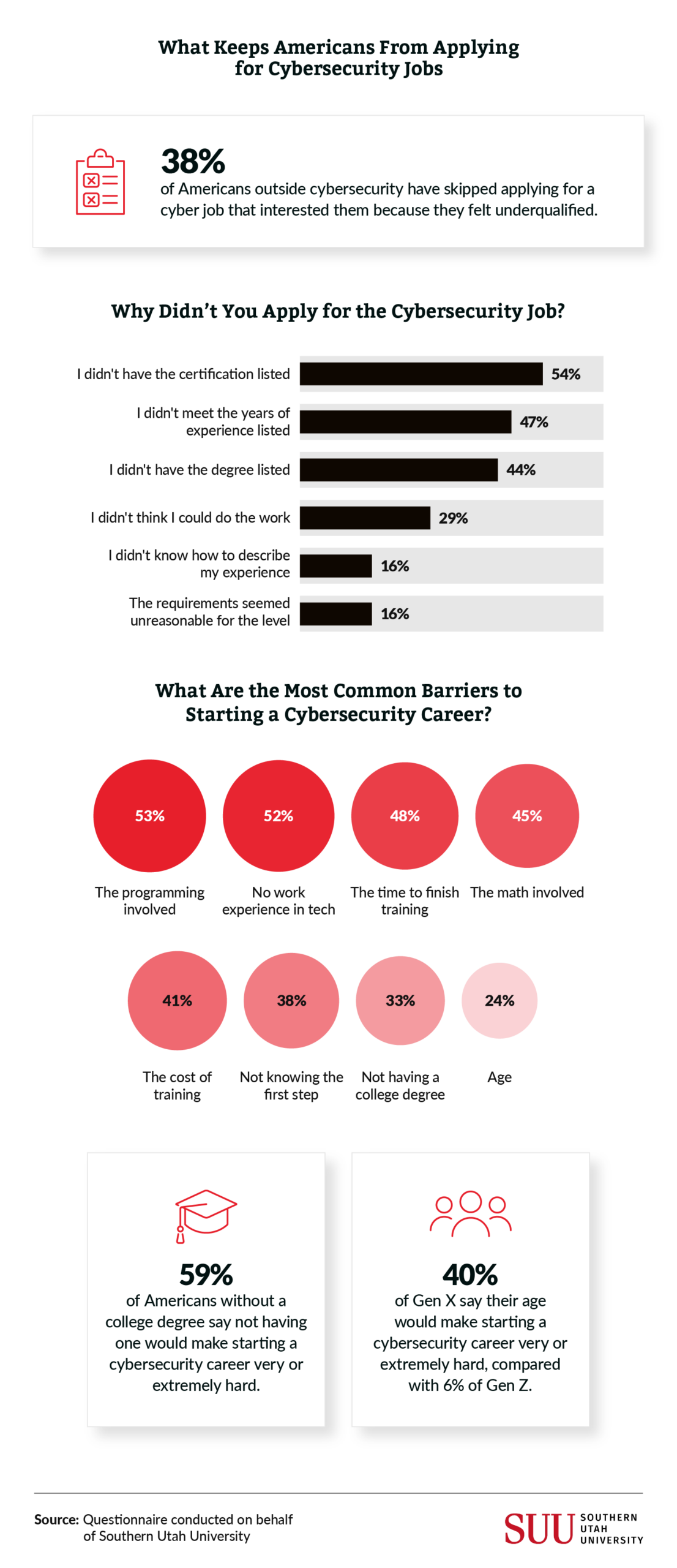
Among Americans who had never worked in cybersecurity, 38 percent reported skipping an application for a cybersecurity job because they felt underqualified. Among those who skipped applying, the most common reasons were not having the certification listed (54 percent), not meeting the years of experience listed (47 percent) and not having the degree listed (44 percent).
Concerns about degrees went beyond individual job postings. Among Americans without a college degree, 59 percent said not having one would make starting a cybersecurity career very or extremely hard. For would-be applicants, perceived gaps in certification, experience or degree can keep them from applying at all, whether or not a posting treats those items as strict requirements.
What Would Motivate Americans to Pursue Cybersecurity Careers?
Respondents pointed to formal training, a manageable pay trade-off and job security as reasons to consider the switch. For a career changer, the practical questions are how long training takes, how much a pay cut costs and how secure the new field will be.
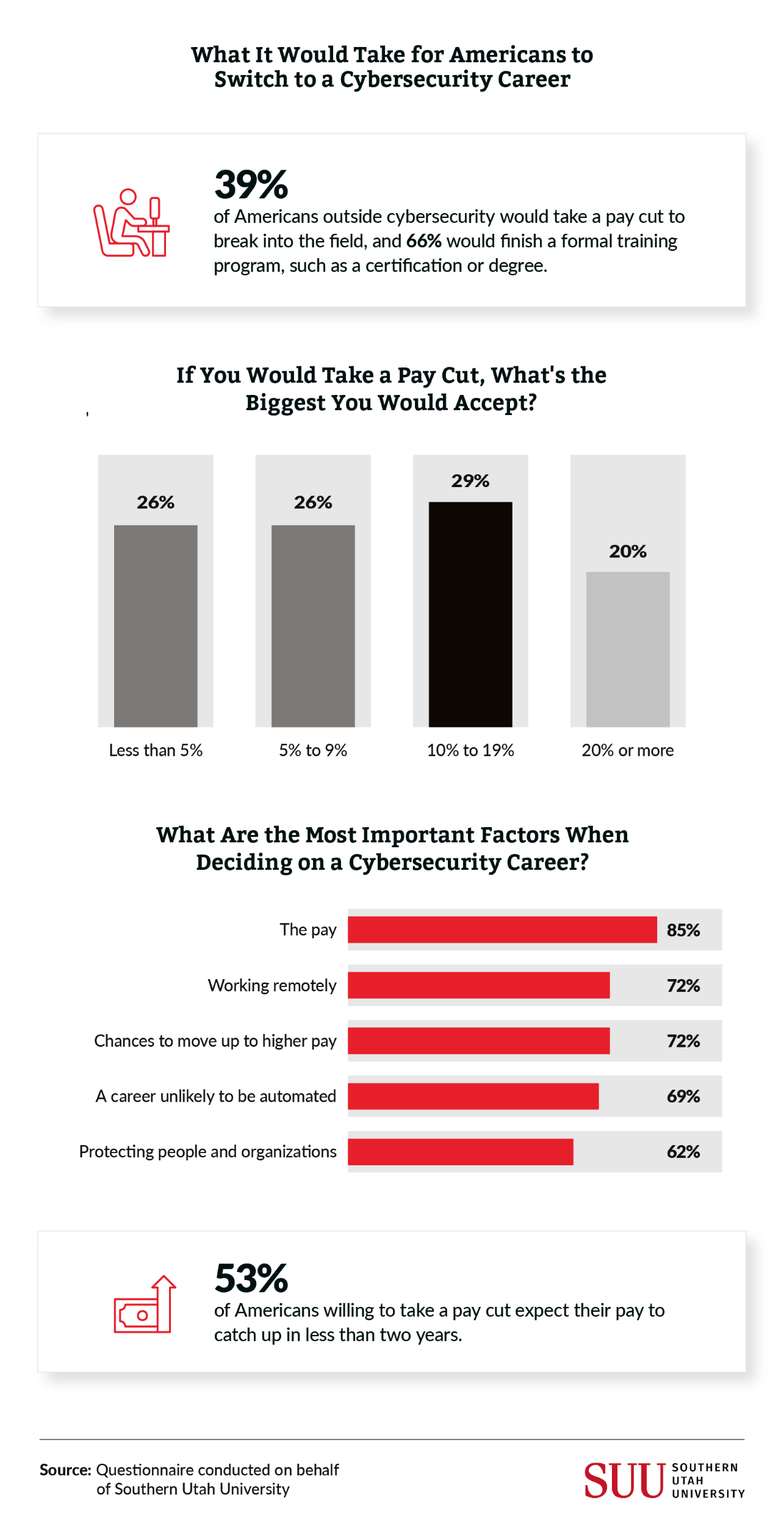
Among Americans outside cybersecurity, 39 percent indicated they would accept a pay cut to enter the field. Of those willing to take a reduction in earnings, 53 percent expected their pay to catch up in less than two years. These responses suggested that some prospective career changers were willing to accept a temporary financial trade-off in pursuit of a new professional opportunity.
Formal education and training also appealed to potential career changers. Among Americans who had never worked in cybersecurity, 66 percent indicated they would complete a formal training program, such as a certification or degree, and 46 percent felt they would realistically complete a cybersecurity certification program. By generation, 48 percent of Gen Z and 46 percent of millennials said they would complete a cybersecurity degree or Graduate Certificate program. Those figures suggest an audience for graduate-level training: SUU’s online M.S. in Cybersecurity with Information Assurance is one option for degree-holders who want it.
Concerns about artificial intelligence (AI) also influenced career priorities. Nearly seven in 10 Americans identified AI-proof careers as a top priority when considering cybersecurity jobs. Yet only 18 percent were very or extremely worried that AI would make their current job obsolete within the next five years, compared with 31 percent who were not worried at all.
Respondents with greater concerns about AI-related job displacement also expressed more willingness to change careers. Among Americans who were very worried about AI taking their jobs, 48 percent said they would accept a pay cut to enter cybersecurity, compared with 30 percent of those who were not worried at all. This difference suggested that concerns about future employment security could influence how workers evaluated the financial costs of entering a new field.
Making Cybersecurity Career Pathways More Accessible
Southern Utah University’s survey revealed a gap between Americans’ interest in cybersecurity and their confidence in pursuing careers in the field. The findings pointed to two needs: clearer information about what entry-level roles require and training that fits around work, since 60 percent of respondents were employed full time.
SUU’s online master’s in cybersecurity delivers coursework asynchronously and can be completed in as few as 11 to 12 months, which speaks to the need for training that fits around work. Students choose among four emphases: Cyber Operations, Cybersecurity Strategy, Healthcare Administration and Management. Readers comparing emphases can review SUU’s state-by-state ranking for cybersecurity workers, its explainer on information assurance and its look at management-track careers before choosing.
Explore SUU’s online Cybersecurity with Information Assurance master’s program to compare emphases and request information.
Methodology
A questionnaire was administered to 577 adults in the United States on behalf of Southern Utah University. The gender breakdown was women (52 percent), men (46 percent) and nonbinary or preferring not to answer (two percent). The generational breakdown was as follows: Gen Z (16 percent), millennials (51 percent), Gen X (28 percent) and baby boomers and older (six percent).
Most respondents (60 percent) were employed full time, 17 percent worked part time, 14 percent were self-employed and nine percent were not currently employed and were looking for work. At the highest level of education completed, 60 percent hold a bachelor’s degree or higher, 9 percent hold an associate degree and 30 percent have a high school diploma, some college or a trade certificate. Six percent currently work in or have previously worked in cybersecurity; questions about career barriers, training and plans were asked only of the 545 respondents who have not.
Averages for questions that asked for a number exclude outliers using the interquartile range (IQR) method. The survey was conducted in October 2026. All percentages are rounded to the nearest whole number, so some totals may not add up to exactly 100 percent.
Fair Use Statement
The findings and information presented in this article may be shared for noncommercial purposes only. Any reproduction or distribution must include proper attribution to Southern Utah University and a link to the original article.
About Southern Utah University
Southern Utah University traces its origins to 1897, when the Utah Legislature called for a teacher training school. Based in Cedar City, Utah, the institution has operated as Branch Normal School, Branch Agricultural College, the College of Southern Utah and Southern Utah State College, and has used its current name since 1991.
SUU’s online master’s in cybersecurity with information assurance appears in Cybersecurity Guide’s 2027 ranking of the most affordable online master’s programs in cybersecurity, where it places 14th. The university also offers a graduate certificate in security information and event management.
