

A college degree can establish a strong foundation for a career, but changing technology and evolving workplace demands can alter which skills professionals need to remain competitive. Artificial intelligence (AI), in particular, is influencing how workers think about their existing education and future learning. A questionnaire conducted on behalf of Southern Utah University (SUU) surveyed 462 employed U.S. professionals with at least a bachelor’s degree to understand how they viewed graduate certificates, specialized master’s programs and other credentials as tools for career growth.
SUU sponsored the research to learn what is bringing professionals back to school and what they hope to gain from an additional credential. Respondents showed interest in shorter, targeted programs as well as specialized master’s degree programs, with cost, career value and employer support all factoring into their decisions. AI has also influenced how many professionals are thinking about the skills they may need next.
Key Takeaways
- 39% of professionals don’t think the degree that launched their career is still enough to keep them competitive.
- 53% of professionals say AI has changed what they would study if they went back to school.
- 38% of professionals are already in a graduate program or plan to enroll within two years.
- 88% of hiring decision-makers say a specialized master’s degree would sway their choice between two similar candidates.
- Professionals expect an average raise of 8% within 12 months of finishing a graduate certificate, and 20% after earning a master’s degree.
- 44% of professionals would stay longer with an employer that funded a graduate certificate.
- 37% of professionals would choose a funded graduate certificate over a 5% raise.
Professionals Are Rethinking What Education They Need
Career-long learning can take many forms, and professionals do not always need to start their education over to develop new expertise. Graduate credentials can provide another layer of education for workers who already have a degree and want to build skills for the next stage of their careers.
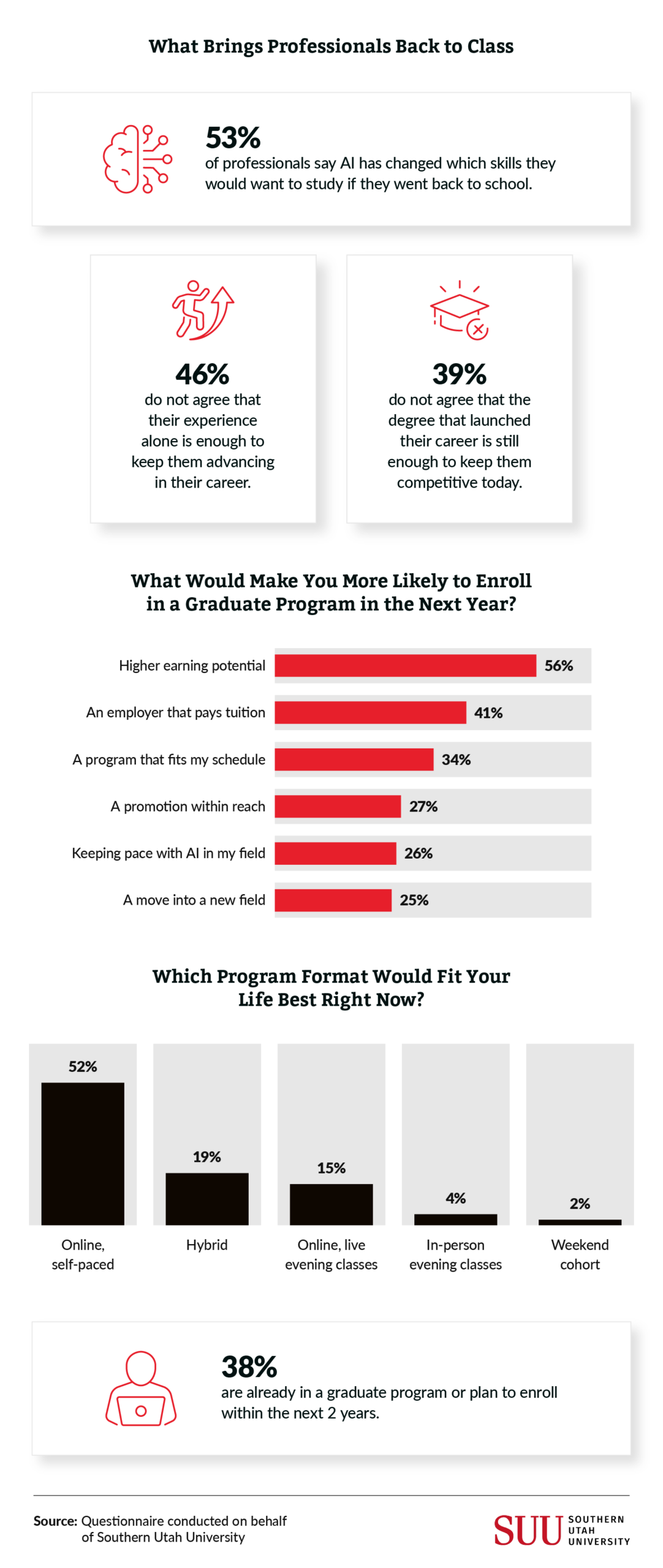
Technological change is influencing how some workers assess their previous education. More than half of professionals (53%) said AI has changed what they would study if they went back to school. Another 34% said advances in AI are making the education they already had less relevant in their field.
More than half (53%) also said shorter, targeted credentials appealed to them more than multi-year degree programs. Meanwhile, 39% did not think the degree that launched their career was still enough to keep them competitive.
For many respondents, further education was already underway or planned. More than one-third (38%) were already enrolled in a graduate program or planned to enroll within two years. Professionals are most interested in an online, self-paced program (52%), followed by a hybrid format (19%) and online, live evening classes (15%).
Specialized Graduate Credentials Could Carry Weight in Hiring
Additional education can serve different purposes depending on where professionals are in their careers. Some may want to strengthen their expertise in a specific area, while others may be considering how an advanced credential could affect future job opportunities and earning potential.
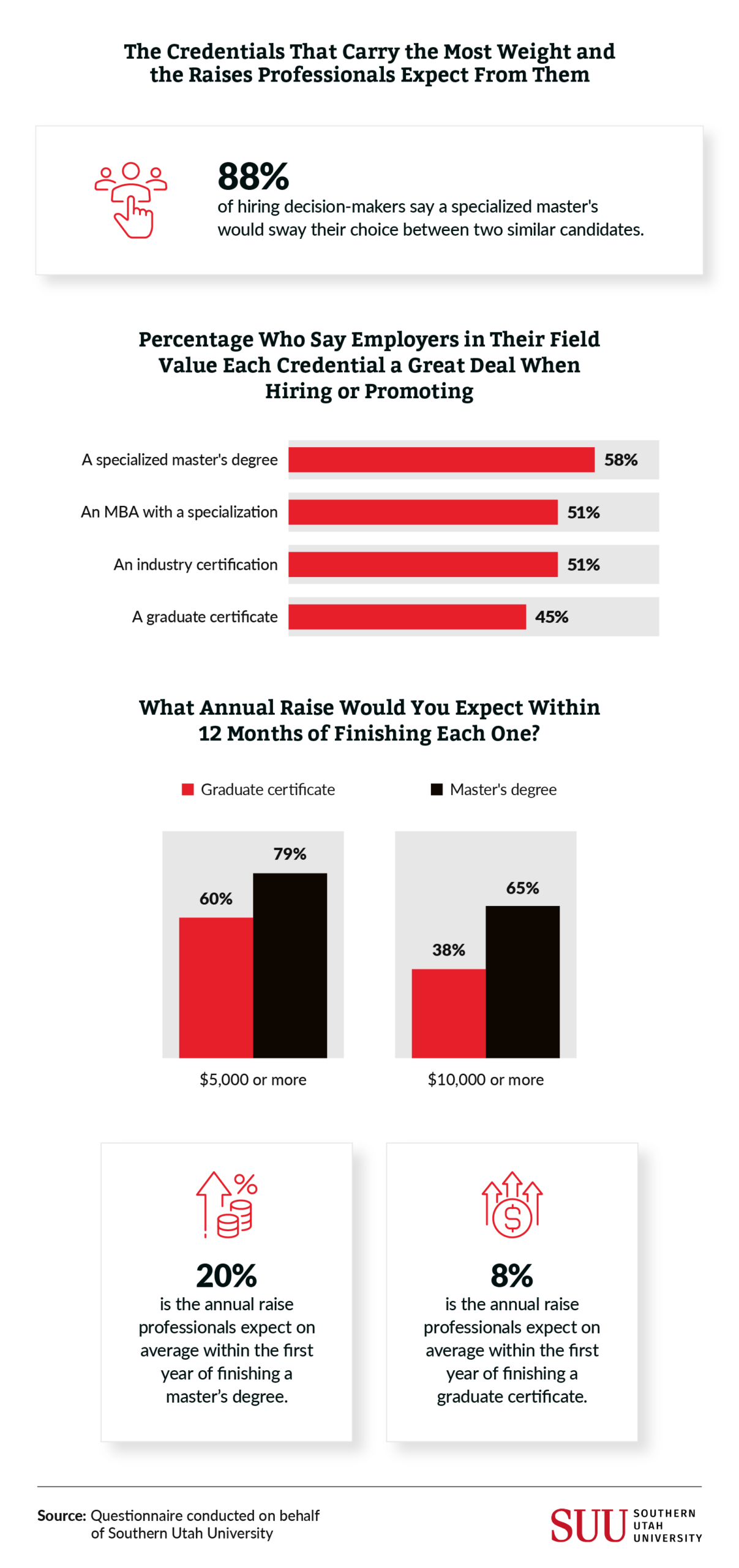
Among respondents who made or influenced hiring or promotion decisions, 88% said a specialized master’s degree would sway their choice between two similar candidates. This finding indicates that specialized graduate education could become a differentiator when candidates otherwise had comparable qualifications.
Professionals also had substantial expectations for the financial value of additional education. They anticipated an average raise of 20% within 12 months of earning a master’s degree, and an average raise of 8% after completing a graduate certificate.
Employer Support Could Influence Education and Retention
The decision to pursue another credential often involves academic interests, career goals and workplace factors. Employer support may also affect whether workers continue their education and how they view their future with an organization.
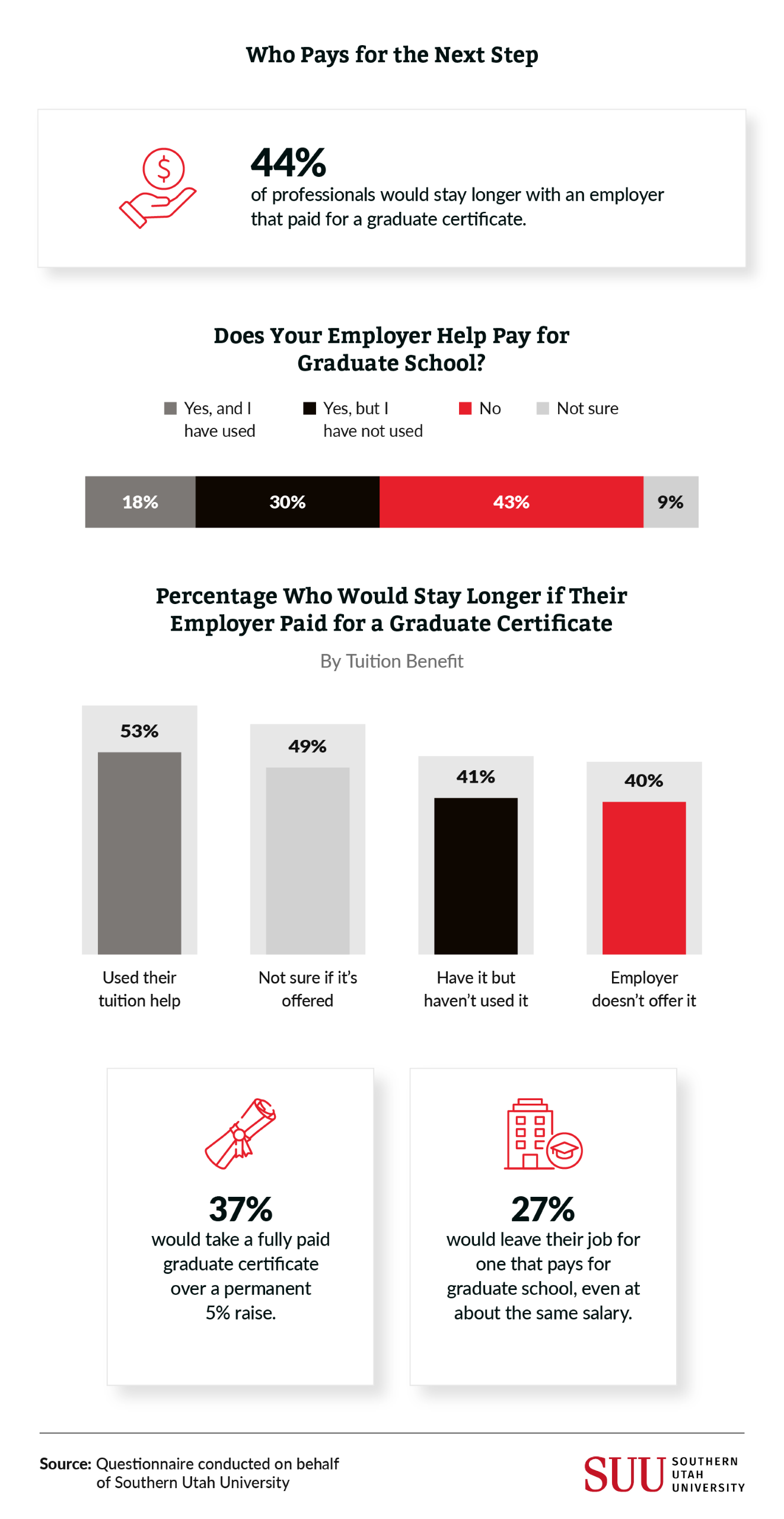
More than two in five professionals (44%) said they would stay longer with an employer that funded a graduate certificate. Another 37% said they would choose a funded graduate certificate over a 5% raise, highlighting the value some respondents placed on employer-supported education. When considering fields for a graduate credential, professionals showed the greatest interest in:
- Information technology or cybersecurity (24%)
- Business administration or general management (23%)
- Data analytics or data science (23%)
- Finance or accounting (18%)
- Healthcare administration (15%)
Other areas of interest included education (13%), marketing or communications (10%), engineering, supply chain or operations (8%) and human resources (8%). Law, compliance or public policy rounded out the list at 6%.
Graduate Education Is Becoming Another Layer in Career Development
For many professionals surveyed, returning to school can be a way to add new skills without abandoning the education and experience they already have. Some are looking at graduate certificates, while others are considering specialized master’s programs, especially as AI changes the skills they expect to need.
Employer support can also make a difference, with some respondents saying funded education could influence whether they stay with an organization. If you’re considering another credential, start by identifying the skills or roles you want to move toward, then compare programs based on cost, time commitment and how well they support that goal. Taking that first step now can set you up for the next stage of your career.
Methodology
On behalf of Southern Utah University, a questionnaire was administered to 462 professionals in the United States about their views on graduate certificates, specialized master’s programs and other credentials as tools for career growth. All respondents are currently employed and hold at least a bachelor’s degree. Half (50%) are managers or supervisors, 41% are salaried professionals without direct reports, and 10% are directors, vice presidents or executives. In addition, 58% make or influence hiring or promotion decisions where they work.
The gender breakdown was men (54%), women (45%) and non-binary or preferring not to answer (1%). The generational breakdown included Gen Z (12%), millennials (55%), Gen X (28%) and baby boomers and older (5%).
At the highest level of education completed, 64% hold a bachelor’s degree, 28% a master’s degree and 8% a doctoral or professional degree. The survey was conducted in September 2026. All percentages are rounded to the nearest whole number. The findings reflect respondents’ self-reported views and expectations at the time of the questionnaire and may not represent all U.S. professionals or predict future career outcomes.
About Southern Utah University
SUU offers online degree and certificate programs designed to help students pursue further education in a flexible format. Its online offerings provide options for professionals who want to build additional knowledge while balancing work and other responsibilities.
SUU’s graduate-level programs may support continued learning and professional development at different stages of a career. SUU’s Dixie L. Leavitt School of Business is accredited by the Association to Advance Collegiate Schools of Business (AACSB), a distinction held by fewer than 6% of business schools worldwide.
Fair Use Statement
The information in this article may be used for noncommercial purposes only. When sharing these findings, please provide proper attribution and a link to SUU.
