

For many adults, going back to school comes after trying other ways to move forward at work. Changing jobs can offer a fresh start, but it does not always provide the career progress people want.
A new questionnaire conducted on behalf of Southern Utah University (SUU) asked adults who had recently returned to school or were planning, considering or wanting to return. Their responses show what they hoped job changes would accomplish, why education eventually became part of the equation and what they expect school to offer that another employer may not.
Key Takeaways
- Nearly 9 in 10 adults heading back to school (86%) have already tried changing jobs, averaging about three roles before seriously considering a return to education.
- Just 22% described their past job changes as mostly real progress, while 59% said they had experienced a mix of progress and lateral moves.
- More than half (55%) believe a degree or credential would help their career more over the next year than switching employers, versus just 12% who would choose another job.
- Higher earning potential is the top reason adults go back to school, cited by 30% of respondents.
- Flexible learning is a dealbreaker, with 62% saying online, hybrid or accelerated options are essential to making school possible.
- Gen Z sees going back to school as a step up, with 73% calling it an upgrade rather than a last resort.
How Much Job-Hopping Comes First
Most respondents had changed jobs before seriously considering school, but they did not always view those moves as upward progress. Their reasons for changing roles ranged from higher pay to stronger job security and more meaningful work.
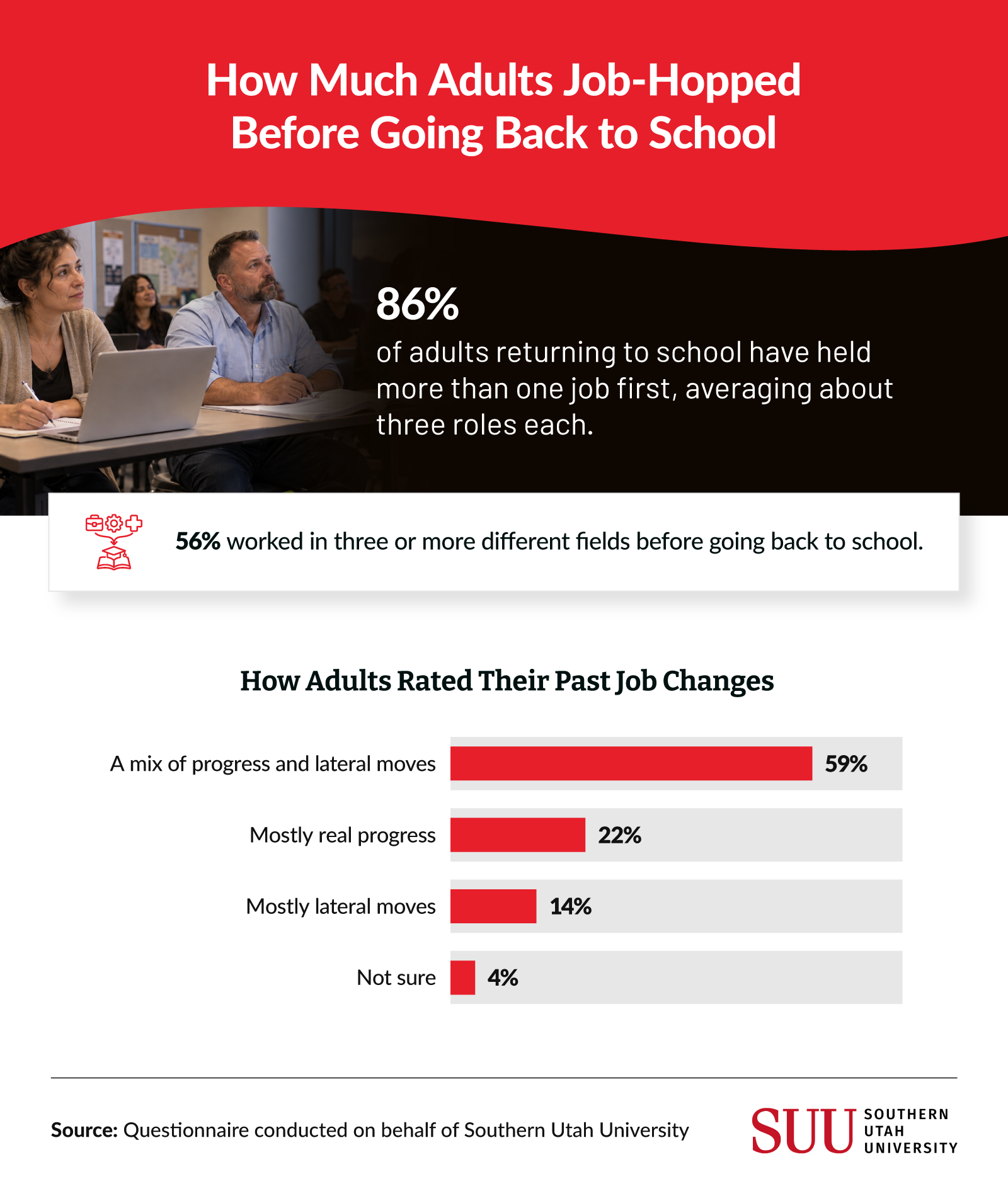
Job changes were already a familiar part of the career path for 86% of adults heading back to school. On average, they had moved through about three roles before seriously considering a return to education. When asked to characterize those moves, 59% described them as a mix of progress and lateral moves, while 22% called them mostly real progress.
Another 14% described their past job changes as mostly lateral, while 4% were unsure. Changing jobs was common among this group, even when respondents did not consistently see those moves as clear advancement.
Among job-changers, 71% said they had hoped for higher pay when making those moves, making it the most common goal. Better work-life balance followed at 44%, while 33% wanted stronger job security and 32% were looking for more meaning or purpose. Women who had changed jobs were more likely than men to say they wanted a healthier workplace culture (30% vs. 21%).
Utah respondents reported similar priorities. One in five Utah adults returning to school (21%) described their past job moves as mostly lateral, while 50% had sought better work-life balance and 38% had wanted more meaning or purpose.
Why Another Job May No Longer Feel Like the Best Move
Many adults in the questionnaire believed education could do more for their career than changing employers over the next year. Their reasons for considering school also point to specific goals, including higher earning potential and access to fields requiring a particular degree or license.
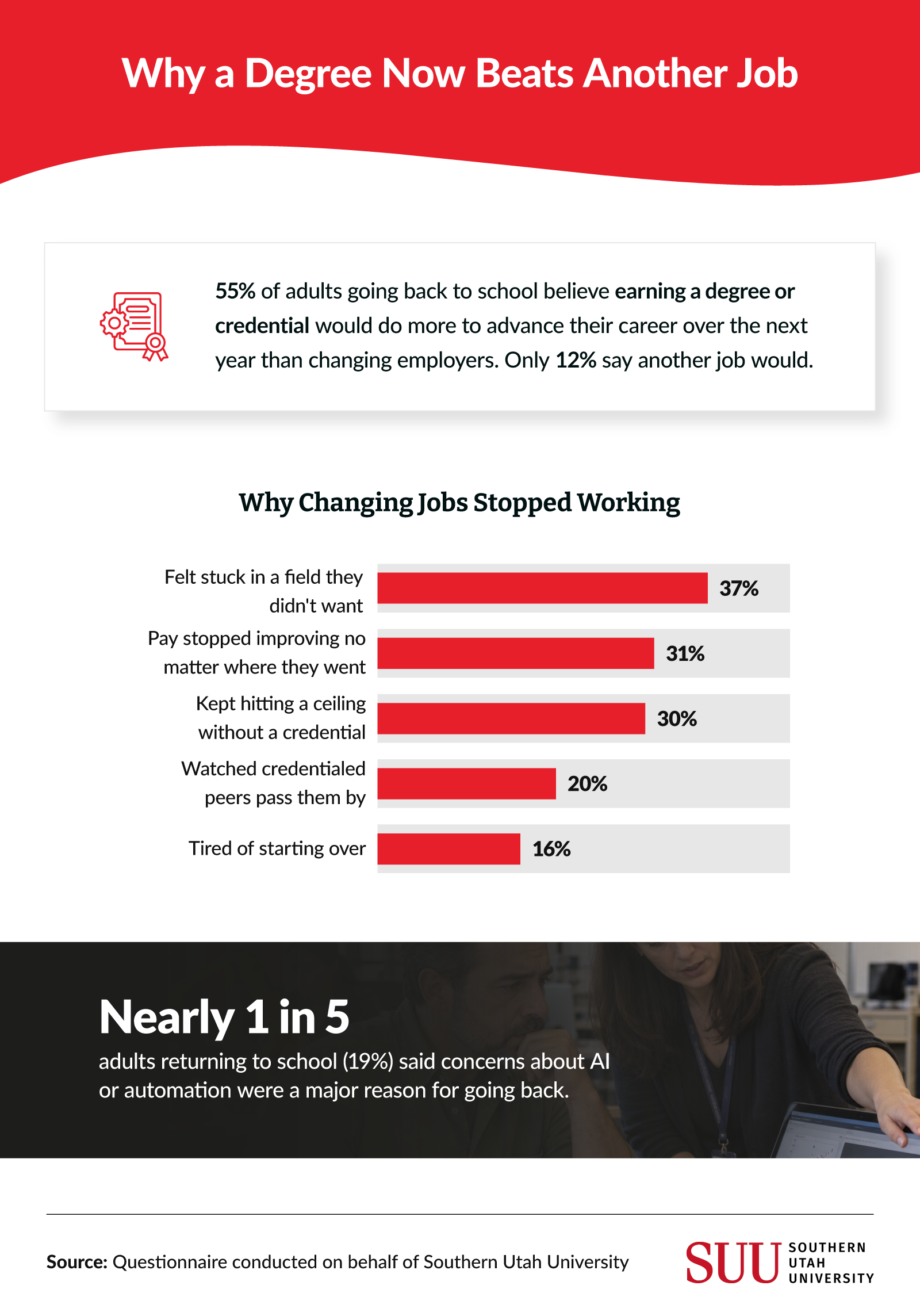
More than half of adults heading back to school (55%) believed earning a degree or credential would do more to advance their career over the next year. By comparison, 12% believed changing employers would do more. Respondents also identified why changing jobs stopped working for them:
- 37% said they felt stuck in a field they did not want.
- 31% said their pay stopped improving no matter where they went.
- 30% said they kept hitting a ceiling they could not clear without a credential.
Another 20% said they had watched credentialed peers pass them by, while 16% were tired of starting over. Overall, higher earning potential was the most common reason why respondents went back to school (30%). Gen Z adults were more likely than millennials to say they returned to earn a specific degree or license to enter the field they wanted (23% vs. 14%). About one in eight adults heading back to school (13%) said they are driven by a sense that they are capable of more than their resume shows.
Utah respondents showed a similar preference for education over a change in employer: 57% believed a degree or credential would do more to advance their career over the next year, compared with 12% who chose changing employers. More Utah respondents also felt stuck in a field they did not want to be in (44%) and that their pay had stopped improving, no matter where they went (35%).
Why Going Back to School Feels Like an Upgrade
Adults also had clear expectations for what education should provide and what would make returning feasible. Career outcomes mattered, but so did a format that accommodated their existing responsibilities.
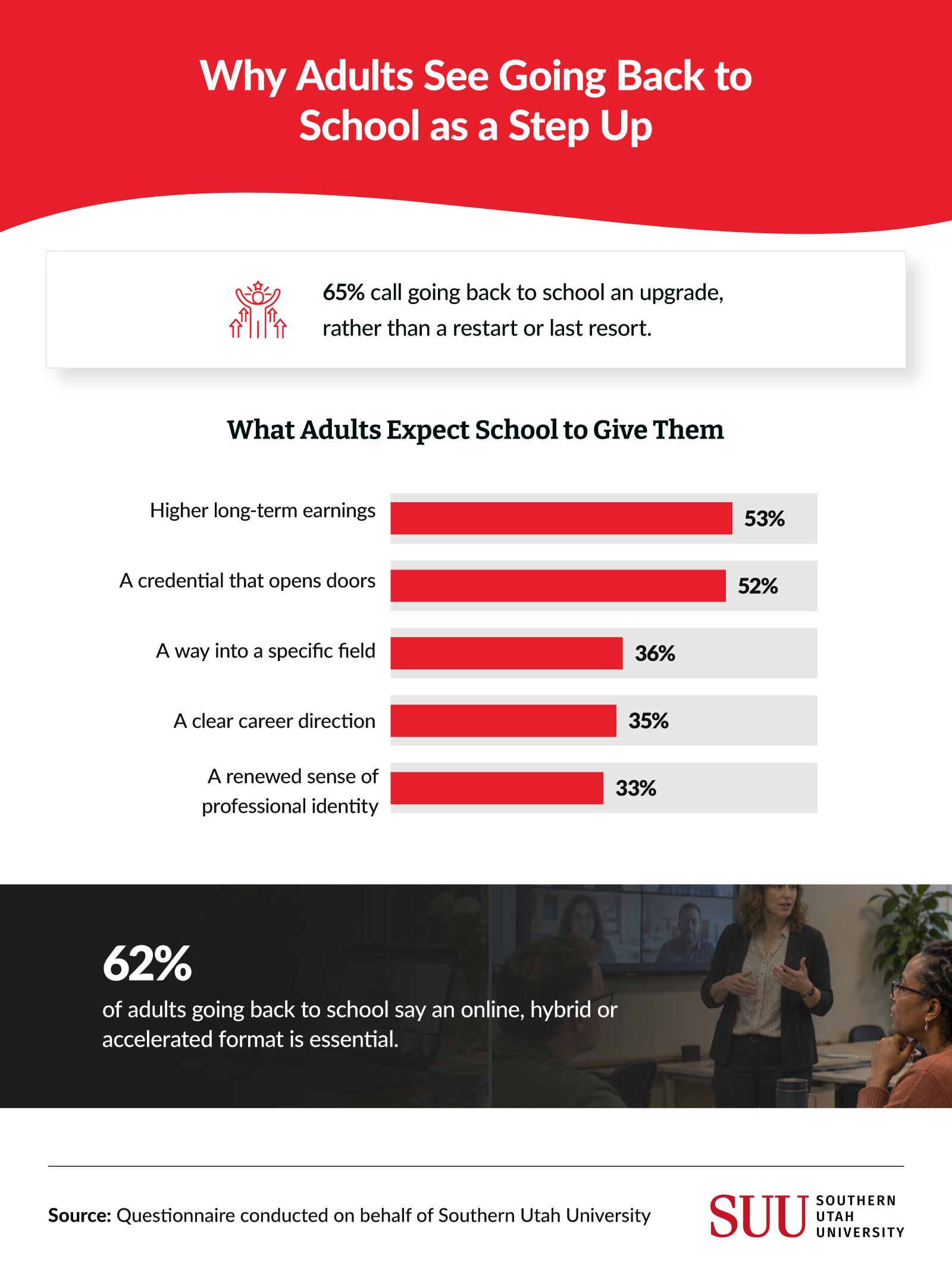
Nearly two-thirds of adults heading back to school (65%) described the move as an upgrade. Gen Z respondents were especially likely to use that description, with 73% calling going back to school an upgrade.
Higher long-term earnings topped the list of what respondents expected or had hoped school would provide, at 53%, followed by a credential that opens doors (52%), a way into a specific field (36%), a clear career direction (35%) and a renewed sense of professional identity (33%).
Flexible learning is a dealbreaker, with 62% saying online, hybrid or accelerated options are essential to making school possible. Women are more likely than men to say so (69% compared with 59%).
Respondents also expressed confidence in the potential value of their education in their local job market. Two in five (40%) said they were very or extremely confident that a degree or credential would pay off in their local job market.
Among respondents who had changed jobs, 49% said they believed they still would have gone back to school even if those job changes had met their career goals. Among those job-changers, adults who had already returned to school were likelier than those still planning to return to say they would have gone back regardless (61% vs. 45%).
Utah respondents placed particular value on where education could take them professionally. Nearly half (47%) expected or hoped for higher long-term earnings, while 46% thought school would provide a way into a specific field. Flexibility also remained important in Utah. More than half of Utah respondents (58%) said an online, hybrid or accelerated format was essential to making their return possible.
From Changing Jobs to Changing Course
Job changes were part of the path for most respondents, but many no longer saw another employer as the strongest next step in their careers. More than half believed a degree or credential would advance their career more over the next year, and nearly two-thirds described going back to school as an upgrade.
For prospective students, the findings highlight the importance of starting with the outcome they want from education. Comparing programs based on career goals, the credentials a field requires and the flexibility needed to balance school with existing responsibilities can help adults choose a path that fits both where they want to go and how they need to get there.
Methodology
A questionnaire conducted on behalf of Southern Utah University included 1,017 U.S. adults age 18 or older who had returned to school within the past two years, were actively planning to enroll, were considering returning but had not decided or wanted to return but had not started. The questionnaire asked about the job changes that led them to return to school and what they expected from further education.
The gender breakdown was women (60%) and men (38%), with 2% non-binary or preferring not to answer. The generational breakdown was millennials (46%), Gen Z (32%), Gen X (20%) and baby boomers (2%).
The questionnaire also included a Utah subgroup of 89 qualified respondents, reported separately where noted. It was conducted in August 2026, and all percentages are rounded to the nearest whole number, so figures may not total 100%. This was a non-scientific, exploratory questionnaire designed to explore behavioral and attitudinal trends. The results are not intended to represent all adult learners.
About Southern Utah University
Southern Utah University offers career-focused online programs designed to give students flexibility as they continue their education. One option is SUU’s 100% online Master of Business Administration (MBA) – General Emphasis, a program covering areas such as accounting, economics, finance, marketing and business strategy.
Fair Use Statement
When referencing this research or its graphics, please credit Southern Utah University and link back to this report. This helps readers locate the original findings and methodology.
