

The decision to go back to school is a decision about what you want from your career and how further education might help you get there. A questionnaire administered on behalf of Southern Utah University asked 944 working professionals across the United States about career advancement, workplace recognition and their interest in returning to school to pursue a graduate business degree. It explored where respondents felt stuck and what would make further education realistic.
Among respondents, 76% reported feeling stalled in their careers, while 80% said a flexible or fully online format would make returning to school realistic. For working adults considering an online degree, these responses offer a starting point for weighing how advanced education can help improve career prospectThey also highlight considerations to work through before enrolling, from the skills needed for a desired role to the cost of pursuing a degree.
Key Takeaways
- 76% of working professionals feel stalled in their careers, stuck just below the level they want for an average of about three years.
- The share of those who have felt stalled rises with age, from 67% of Gen Z to 75% of millennials and 77% of Gen X.
- 61% of professionals have watched someone with less experience get promoted ahead of them, and 46% say that person held a degree they lacked.
- 58% of Gen X professionals wished they had pursued a graduate degree sooner, the highest of any generation.
- 81% of professionals would enroll if their employer covered the full cost, yet only 29% believe their employer would pay for their program.
- 80% of professionals say a flexible or fully online format is what would make going back to school realistic for them.
- 74% of professionals say a guaranteed raise motivates a return to school more than a guaranteed promotion (61%), and they expect a degree to lift their pay by roughly 23%.
- 79% of professionals have never told their manager they feel stuck.
The Ceiling That Keeps Professionals Stuck Below the Next Level
For most professionals, the problem is not effort. It is the sense of having hit a ceiling just below the level they want to reach.
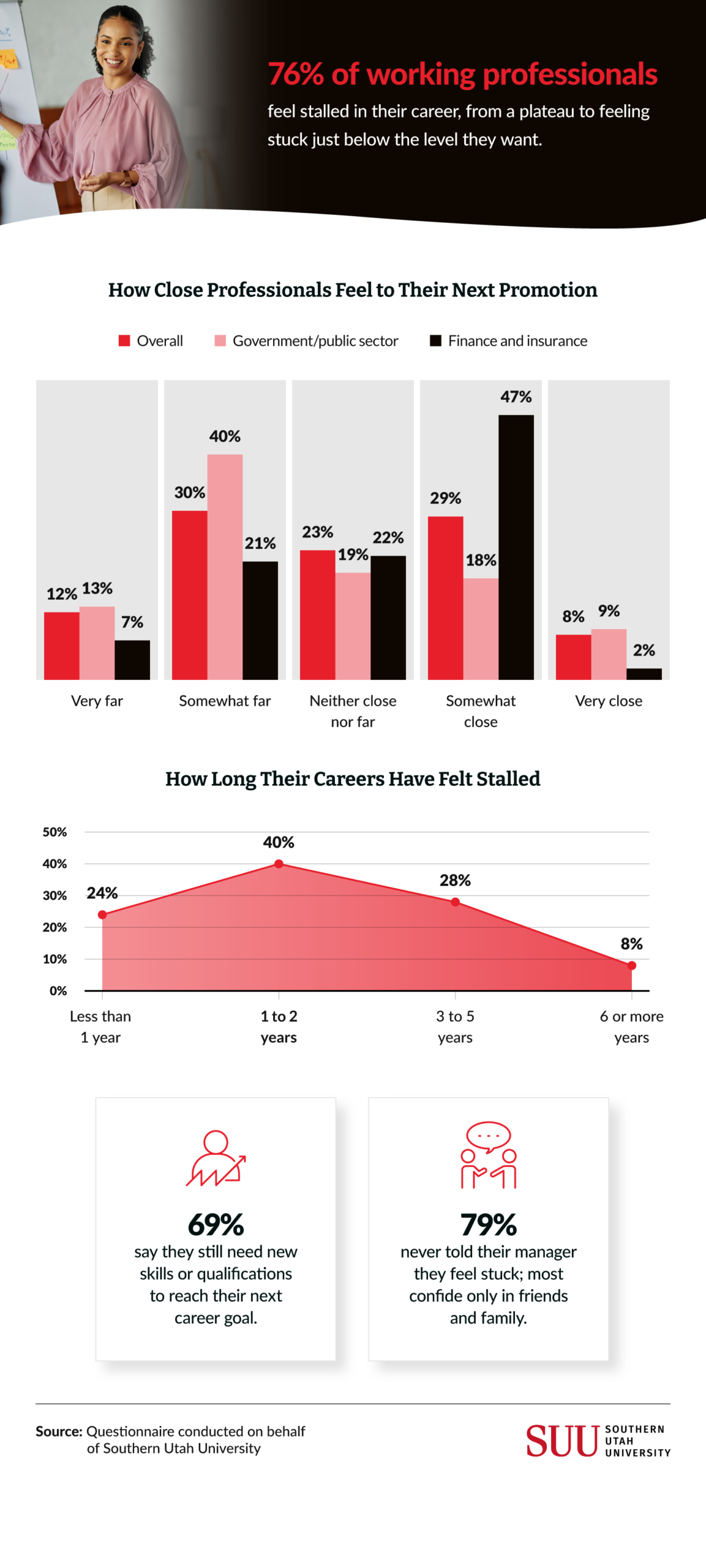
Roughly three in four working professionals fell into the stalled group, stuck just below their target level for an average of about three years (76%). The wait tended to stretch with age, as Gen X professionals reported stalling for about four years, millennials for about three and Gen Z for about two. The share who had ever felt stuck rose the same way, from 67% of Gen Z to 75% of millennials and 77% of Gen X.
For most, the stall was measured in years, not months. About 40% had been stuck for one to two years, 28% for three to five and 8% for six or more. Only 24% had felt stalled for less than a year. That sense of having leveled off also deepened with age. 52% of Gen X said their career had plateaued, compared with 44% of millennials and 33% of Gen Z.
Overall, 42% of professionals said they felt far from their next promotion, outnumbering the 38% who felt close to it. Many respondents (69%) said they still needed new skills or qualifications to get there.
Senior individual contributors felt it most, with 49% saying their career had plateaued compared with 36% of managers. Even so, most said nothing about it. Nearly four in five professionals (79%) had never told their manager they felt stuck, and 24% had told no one at all.
The Skills and Recognition Professionals Want to Build
Professionals identified decision-making confidence and leadership skills as their most common barriers to advancement. Their responses also showed where they believed a graduate degree could help.
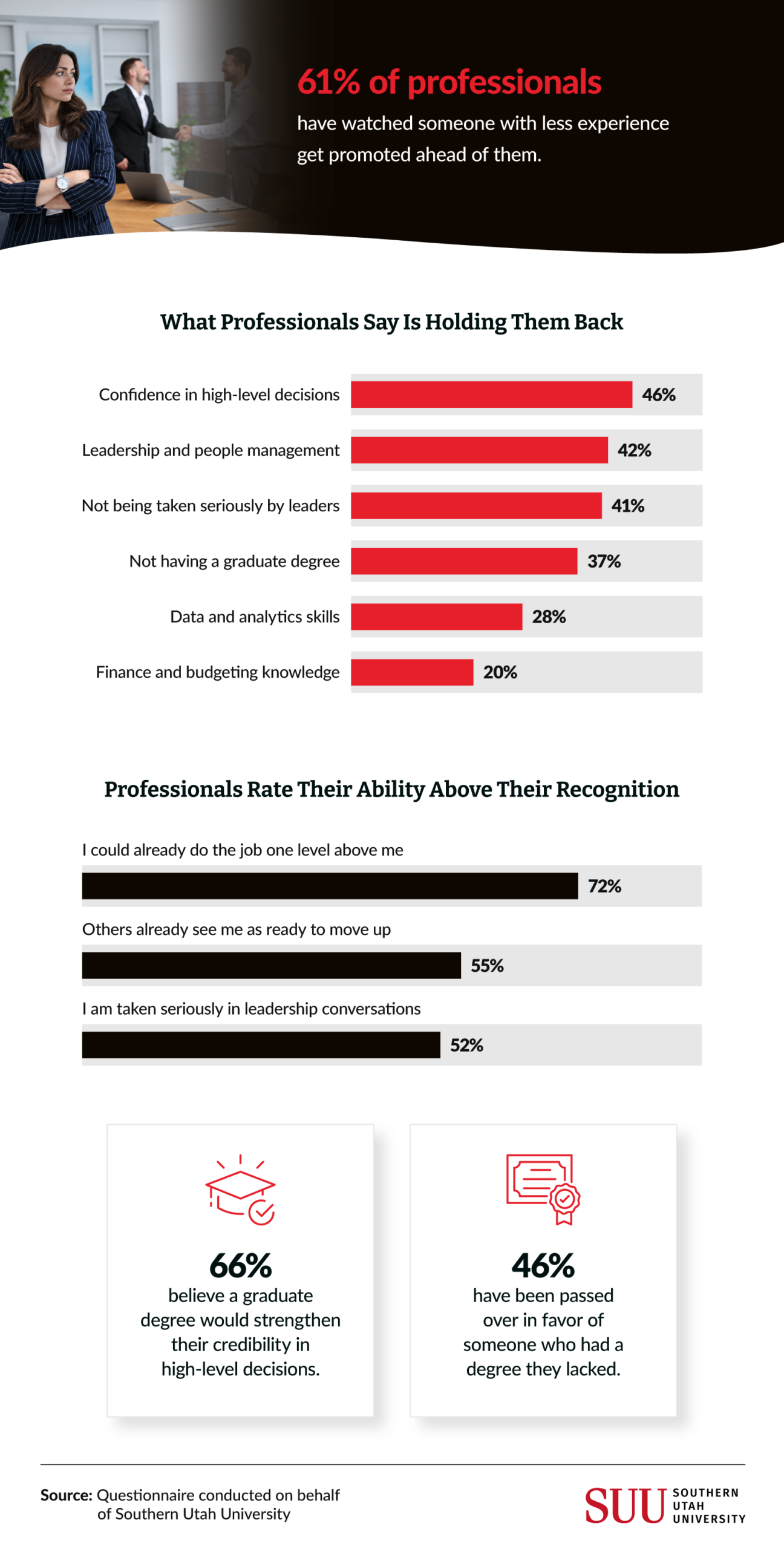
When sharing what’s holding them back in their careers, confidence in high-level decisions topped the list at 46%. Leadership and people management (42%) and not being taken seriously by leaders (41%) followed. More than a third (37%) identified not having a graduate degree as a barrier.
Feeling capable did not always mean feeling recognized. Nearly three in four professionals (72%) said they could already do the job one level up, but fewer believed others saw them as ready (55%) or that they were taken seriously in leadership conversations (52%). Among stalled professionals, 47% felt taken seriously in those discussions, compared with 70% of their advancing peers.
Many respondents (61%) had watched someone with less experience get promoted ahead of them, and 46% had seen someone promoted ahead of them who held a degree they lacked. Two in three (66%) believed a graduate degree would strengthen their credibility in high-level decisions, tying with earning power as the top expected benefit.
The Tipping Point for Going Back to School
Interest in going back to school was clearly there. What professionals weighed was cost, time and whether the payoff would be worth it.
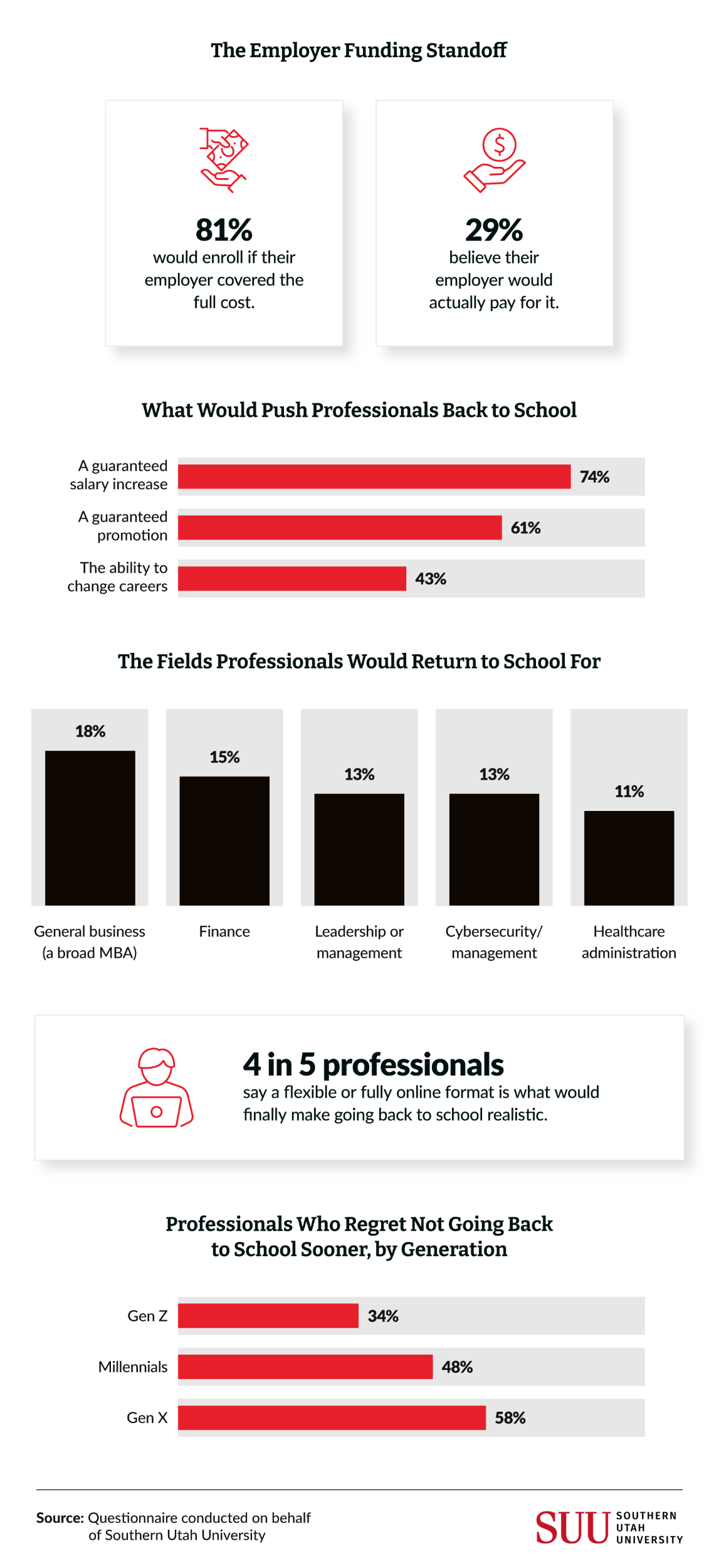
Cost was the single biggest barrier standing between professionals and enrollment, named by 69%, ahead of balancing school with work (50%) and uncertainty about the payoff (50%). Employer support moved the needle in direct proportion to the amount covered. A large majority (81%) would enroll if their employer paid the full cost, 49% if it covered half and 23% for a quarter, yet only 29% believed their employer would pay.
A broad business degree was the field professionals would most likely return to, with a general business degree/MBA at 18%, followed by finance (15%) and cybersecurity management and leadership (tied at 13%)
Format mattered as well. Four in five professionals (80%) said a flexible or fully online option would make returning realistic. On average, professionals expected a degree to raise their pay by about 23%, and a guaranteed raise would motivate a return more than a guaranteed promotion (74% vs. 61%).
Older workers were the most likely to wish they had acted sooner, with 58% of Gen X saying they wished they had pursued a graduate degree earlier, the highest of any generation. For many, the goal was a change of direction as much as a climb, as 38% said they would use a degree to pivot into a different role or industry rather than climb their current ladder. And nearly half (49%) believed a targeted certification or bootcamp could also help them advance.
From Stalled to Moving Again
Many professionals in the questionnaire felt ready for more responsibility but weren’t sure others saw them that way. Respondents viewed a graduate degree as a potential way to build credibility and increase their earning power, though cost and balancing school with work remained concerns.
For working adults considering a return to school, a useful starting point is identifying the skills and qualifications their next role requires. Comparing those needs with what an online graduate program offers, alongside its cost and schedule, can help them make a decision that fits their career goals and daily life.
Methodology
A questionnaire, conducted on behalf of Southern Utah University, surveyed 944 working professionals across the United States about career advancement, workplace recognition and attitudes toward returning to school for a graduate business degree. The survey was fielded through CloudResearch Connect in August and September 2026. Only respondents with a unique participant ID who passed an embedded attention check were retained in the final sample.
Percentages were calculated using valid non-null responses to each question as the denominator, and “not applicable” responses were excluded from matrix items. For questions where respondents could select more than one option, percentages reflect the share of all respondents and can total more than 100%. All figures were rounded to the nearest whole number, and multi-option distributions were balanced using the largest-remainder method so totals sum to 100%. Demographic breakdowns are reported only for subgroups representing at least 5% of the total sample.
Generation
- Millennials (ages 30 to 45): 516 (55%)
- Gen Z (ages 18 to 29): 206 (22%)
- Gen X (ages 46 to 61): 206 (22%)
- Baby boomers (ages 62 and older): 16 (2%)
Gender
- Female: 506 (54%)
- Male: 424 (45%)
- Non-binary: 11 (1%)
- Prefer not to say: 3 (less than 1%)
Household income
- $50,000 to $74,999: 259 (27%)
- $75,000 to $99,999: 199 (21%)
- $25,000 to $49,999: 178 (19%)
- $100,000 to $149,999: 146 (15%)
- Less than $25,000: 73 (8%)
- $150,000 to $199,999: 43 (5%)
- $200,000 or more: 34 (4%)
- Prefer not to say: 12 (1%)
Job level
- Mid-level or senior individual contributor: 333 (35%)
- Entry-level or individual contributor: 323 (34%)
- Manager: 225 (24%)
- Director: 35 (4%)
- Self-employed or business owner: 20 (2%)
- Vice President: 8 (1%)
Years of experience
- More than 20 years: 255 (27%)
- 6 to 10 years: 189 (20%)
- 11 to 15 years: 178 (19%)
- 16 to 20 years: 144 (15%)
- 2 to 5 years: 141 (15%)
- Less than 2 years: 34 (4%)
- Prefer not to say: 3 (less than 1%)
Industry
- Technology and software: 153 (16%)
- Healthcare: 129 (14%)
- Finance and insurance: 112 (12%)
- Education: 100 (11%)
- Retail, wholesale or consumer goods: 91 (10%)
- Other, 89 (9%)
- Professional, scientific or business services: 82 (9%)
- Government or public sector: 67 (7%)
- Manufacturing: 54 (6%)
- Transportation, energy or utilities: 34 (4%)
- Nonprofit or social services: 33 (3%)
About Southern Utah University
Southern Utah University offers flexible online degree programs built for working adults who want to advance without stepping away from their careers. Our online Master of Business Administration (MBA) program equips graduates with specialized skills and credentials, preparing them to qualify for leadership, finance and management roles.
Fair Use Statement
We welcome the noncommercial reuse of this research and its assets. If you share these findings, please attribute them to Southern Utah University by linking back to this page so readers can explore the full study.
