

Strong communication skills influence how professionals lead teams, build relationships and advance their careers. A questionnaire administered on behalf of Southern Utah University (SUU) surveyed professionals enrolled in MBA programs about the skills that have contributed most to their career advancement and the areas in which they feel least prepared. Respondents also shared which qualities they believe will matter most in the workplace as AI becomes more common.
Many respondents said career advancement depends on more than technical expertise. They pointed to strong communication, greater visibility and the ability to earn the trust of colleagues and leaders as skills that can help open the door to new opportunities. For professionals considering an MBA, the results offer insight into the leadership skills employers value and the areas where continued development can support career growth.
Key Takeaways
- 94% of professionals enrolled in an MBA program say communication has been important to their career advancement, but only 78% rate their own ability as strong.
- 57% of professionals say communicating clearly to leadership mattered more than they had expected once they entered the workforce.
- 90% of professionals say communication is the most important factor for career advancement today.
- Executive presence (38%) and personal branding and reputation (36%) are among the areas where professionals most often feel underprepared.
- 52% of professionals say that personal branding and reputation should be required parts of an MBA, and 84% already credit their program with building their leadership presence and personal brand.
- 70% say interpersonal and leadership skills matter more in the workplace today than they did five years ago, before AI was part of everyday work.
Communication Drives Career Growth
Communication has become one of the most valuable skills for career advancement, and many professionals believe it deserves more attention in graduate business education. Respondents enrolled in MBA programs recognized communication as a key driver of leadership and workplace success and identified opportunities to strengthen their own abilities.
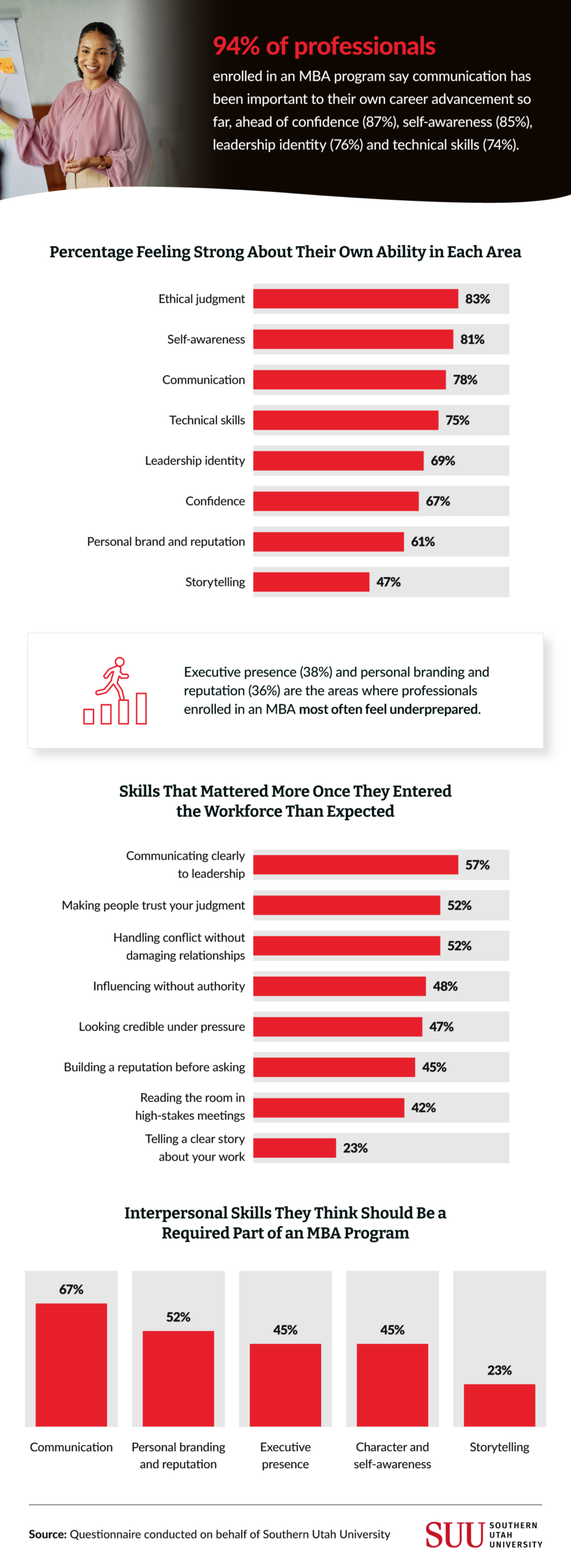
Communication stood out as the skill professionals valued most. Nearly all respondents (94%) said it had been important to their career advancement, yet only 78% felt confident in their own communication abilities. Confidence (87%), self-awareness (85%), leadership identity (76%) and technical skills (74%) also ranked among the most important contributors to career growth, suggesting that professionals view both interpersonal and technical strengths as essential for long-term success.
Many respondents said they underestimated the importance of these skills before entering the workforce. More than half (57%) reported that communicating clearly with leadership became more important than they had expected, while 52% said earning others’ trust and handling conflict without damaging relationships proved more valuable than anticipated. Nearly half also found that influencing without formal authority (48%) and projecting credibility under pressure (47%) became increasingly important as their careers progressed.
Although respondents generally felt confident in areas such as ethical judgment (83%) and self-awareness (81%), many identified leadership presence as an opportunity for growth. Executive presence was the area where professionals most often felt underprepared (38%), followed closely by personal branding and reputation (36%). Reflecting those priorities, two-thirds (67%) said communication should be a required part of every MBA program, while about half supported required coursework in personal branding and reputation (52%) and executive presence (45%).
Career Advancement Depends on More Than Technical Skills
Strong technical skills remain important, but professionals enrolled in MBA programs said they are only one part of career advancement. Respondents emphasized that communication, visibility and professional relationships can play a significant role in earning recognition, promotions and leadership opportunities.
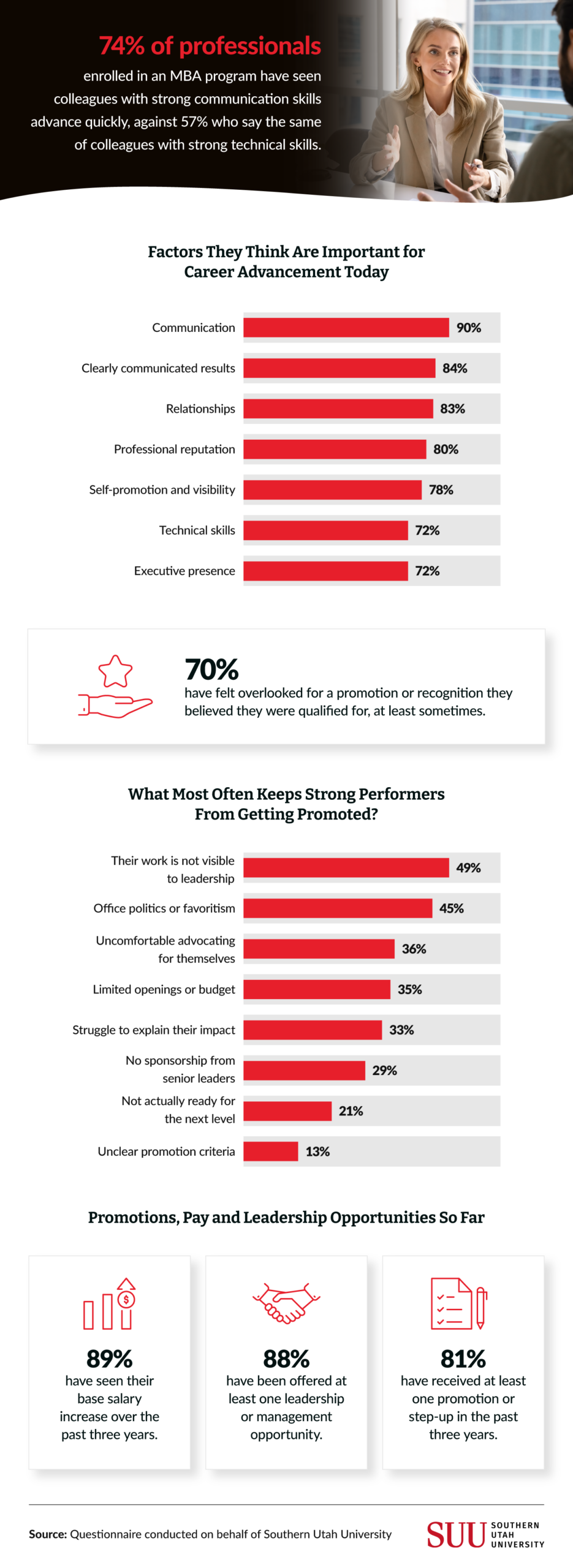
Communication continued to stand out as the most important factor for career advancement. Nine in 10 respondents (90%) said communication is important for career growth today, followed by clearly communicating results (84%), building relationships (83%), professional reputation (80%) and self-promotion and visibility (78%). Technical skills also remained important (72%), but respondents placed interpersonal and communication skills at the top of the list.
Many participants had seen the impact of those skills firsthand. Nearly three-quarters (74%) said they had watched colleagues with strong communication skills advance quickly, compared with 57% who said the same about colleagues with strong technical skills. The findings suggest that professionals often associate career progression with the ability to communicate effectively, build trust and make meaningful contributions visible to leaders.
Despite recognizing these qualities, many respondents reported experiencing challenges in their own careers. Seven in 10 (70%) said they had been overlooked for a promotion or recognition they believed they were qualified for, at least sometimes. The most cited reason strong performers miss promotions was that their work is not visible to leadership (49%), followed by office politics or favoritism (45%).
Even so, many respondents reported positive career momentum. Nearly 9 in 10 (89%) had received a base salary increase during the past three years, 88% had been offered at least one leadership or management opportunity and 81% had earned a promotion or stepped into a higher-level role. Combining technical expertise with strong communication and professional visibility can help professionals prepare for continued career growth.
Human Skills Stand Out in the Age of AI
As AI becomes part of more workplaces, professionals believe certain skills are becoming even more valuable. Respondents enrolled in MBA programs pointed to communication, leadership and relationship-building as qualities that help professionals stand out.
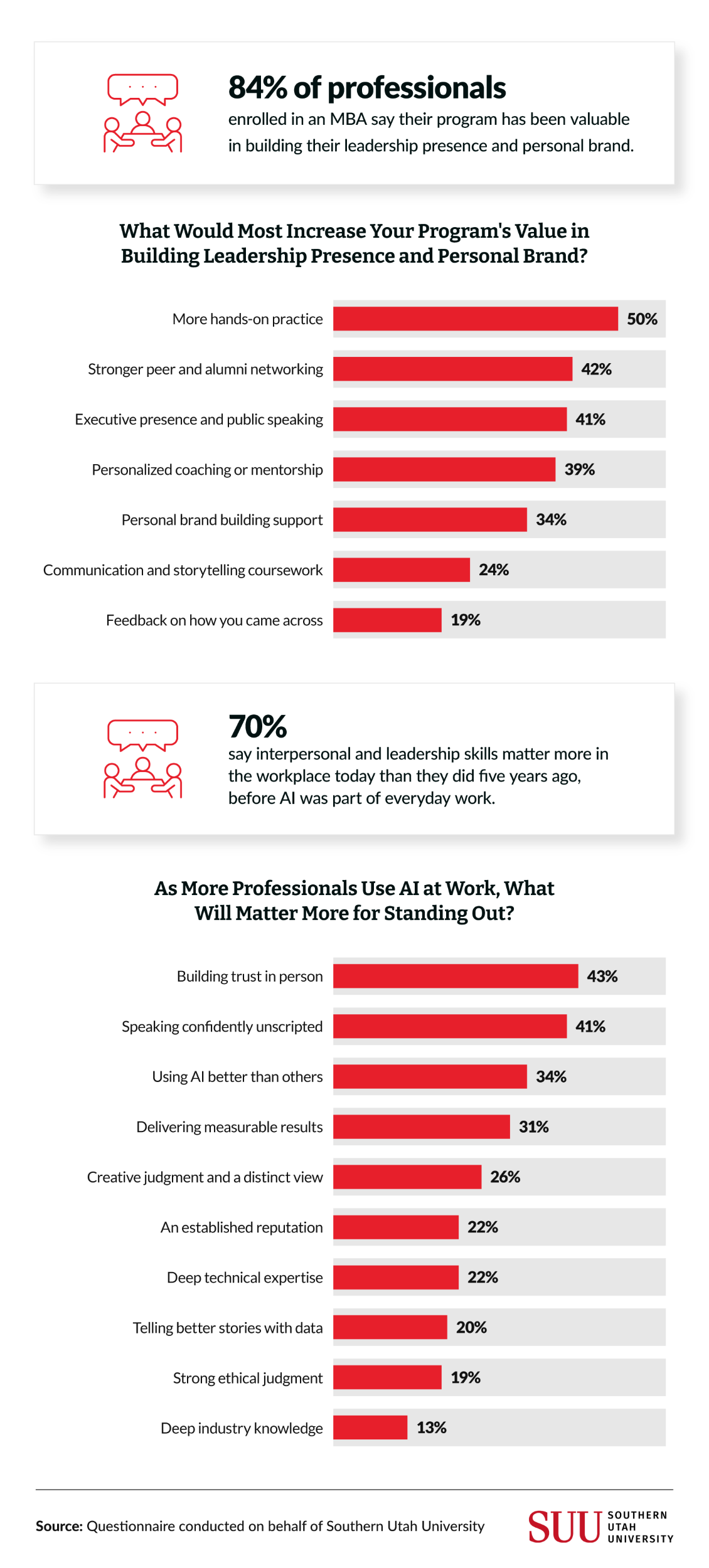
Seven in 10 respondents (70%) said interpersonal and leadership skills matter more in today’s workplace than they did five years ago, before AI became part of everyday work. Rather than viewing technical expertise as the primary differentiator, respondents most often said building trust in person (43%) and speaking confidently without a script (41%) will become increasingly important for standing out. Using AI more effectively than others ranked third at 34%, suggesting professionals see technology skills as most valuable when paired with strong interpersonal abilities.
Many respondents also saw opportunities for MBA programs to further strengthen these leadership skills. Half (50%) said more hands-on practice would increase their program’s value in developing leadership presence and personal brand, followed by stronger peer and alumni networking (42%), executive presence and public speaking (41%) and personalized coaching or mentorship (39%).
Most respondents viewed their MBA experience positively. More than 4 in 5 (84%) said their program has been valuable in building their leadership presence and personal brand. Together, the findings suggest that while AI is reshaping the workplace, professionals continue to see communication, leadership and authentic human connection as essential skills for career success.
Preparing Leaders for a Changing Workplace
Career advancement depends on a combination of technical knowledge and the ability to communicate, build trust and lead others effectively. Professionals enrolled in MBA programs consistently identified communication, visibility and interpersonal skills as qualities that help transform strong performance into new opportunities.
Turning that recognition into results often starts with a clear plan. Graduate business education can provide opportunities to develop both technical and interpersonal skills, including goal-setting strategies that turn career ambitions into measurable progress.
Methodology
A questionnaire conducted on behalf of SUU surveyed 283 professionals enrolled in an MBA program about career advancement and the skills that drive it. Respondents were 51% women, 48% men and 1% non-binary or preferring not to answer. The generational breakdown was as follows: millennials (53%), Gen X (23%), Gen Z (18%) and baby boomers (6%). All respondents were working, with 84% employed full-time, 12% part-time and 4% self-employed.
The survey was conducted in July 2026. All percentages are rounded to the nearest whole number.
About Southern Utah University
Southern Utah University offers a fully online MBA – General Emphasis program designed for working professionals who want to pair technical know-how with leadership skills. The 33-credit-hour program builds skills in finance, marketing, accounting and economics alongside leadership, strategy and corporate responsibility and ESG principles, and it can be completed in as few as 12 months without requiring GMAT scores. Courses run in seven-week terms with multiple start dates each year, giving working professionals flexible ways to fit graduate school around their careers.
Fair Use Statement
The information presented in this article may be shared for noncommercial purposes only. When referencing or republishing these findings, please provide proper attribution and include a link to Southern Utah University so readers can access the original research.
