

Cybercrime losses in the U.S. surpassed $20 billion in 2025, yet the cybersecurity workforce remains unevenly distributed across the country. To understand where demand for skilled professionals is highest, an analysis of seven metrics spanning cybercrime exposure, analyst employment, wages and education interest across all 50 states was conducted on behalf of Southern Utah University (SUU). The result is the Cybersecurity Workforce Pressure Index, a comprehensive ranking that reveals which states offer the strongest opportunities for cybersecurity professionals and where the field remains underdeveloped.
Not every state with high cybercrime rates has the workforce to match. By weighing threat exposure alongside talent supply, compensation data and the surge in education interest, this analysis identifies the markets where cybersecurity skills are most needed and most rewarded.
Key Takeaways
- Maryland is the best state for cybersecurity workers, ranking second in the country for cybersecurity analyst employment density and third for mean analyst wages, while also posting above-average cybercrime exposure, signaling both strong demand and an established talent market.
- Louisiana ranks last overall, posting some of the country’s lowest mean wages (No. 47) and projected 10-year job growth (No. 41).
- Alaska leads the nation in cybercrime complaints at 434.3 per 100K residents.
- Search interest in cybersecurity education grew 13% nationwide from 2023 to 2025 on a monthly average basis. Rhode Island saw the largest increase at 111%, followed by Montana at 81%.
- Delaware (278.8) and Maryland (278.1) lead the nation in cybersecurity education searches per 100K residents.
The Cybersecurity Workforce Pressure Index
Cybercrime losses hit record highs nationally, but the states feeling the most pressure aren’t always the ones you’d expect. Here’s how all 50 states rank when threat exposure, workforce supply, wages and education demand are weighed together.
Maryland ranked first overall, leading the index on the strength of its analyst workforce density and mean wages, while also posting above-average cybercrime exposure. Nevada followed in second, ranking second in the country for both cybercrime complaints and financial losses per capita, signaling strong demand for qualified professionals. Virginia rounded out the top three, posting the highest analyst employment density of any state.
Rounding out the bottom of the index were Louisiana, Mississippi, Kentucky, Maine and Iowa. Louisiana ranked last overall, recording the lowest per capita financial losses in the country and the 46th-highest complaint rate. These findings signal relatively low demand for cybersecurity professionals.
Breaking Down the Pressure by Factors
The overall index tells one story, but the individual metrics reveal another. From cybercrime complaints to projected job growth, here’s where the top and bottom states stand across every dimension of cybersecurity pressure.
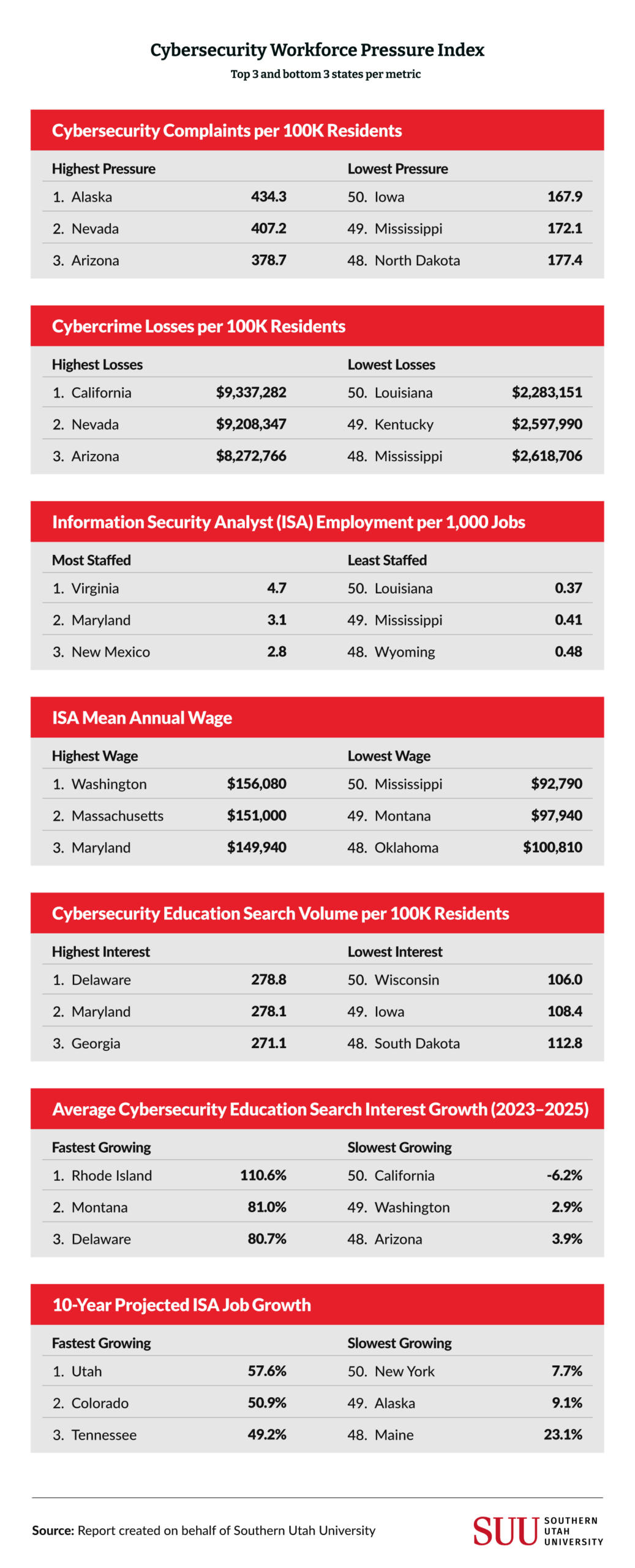
Alaska led the nation with 434.3 cybercrime complaints per 100,000 residents, more than 2.5 times Iowa’s rate of 167.9. The gap between the most and least exposed states underscores how unevenly cybercrime activity is distributed across the country.
Washington state paid security analysts a mean salary of $156,080, while Mississippi paid just $92,790, a difference of more than $63,000 between the highest and lowest paying states. Where high wages and elevated cybercrime exposure overlap, the labor market tends to be strong for professionals entering the field.
Louisiana had just 0.37 security analysts per 1,000 workers, while Virginia had 4.7, more than 12 times the analyst density. Delaware and Maryland led the nation in cybersecurity education searches per capita, with 278.8 and 278.1 searches per 100,000 residents, respectively, reflecting strong and sustained interest in credential attainment in those markets.
Where Interest in Cybersecurity Education Is Growing Fastest
Searches for cybersecurity degrees, certificates and master’s programs have steadily increased nationwide (13%) in just two years, but some states are pulling far ahead of the pack. Rhode Island saw the largest increase at 111%, followed by Montana at 81% and Delaware at 81%.
States With the Highest Average Cybersecurity Education Search Volume Growth
- Rhode Island (110.6%)
- Montana (81.0%)
- Delaware (80.7%)
- North Dakota (75.0%)
- Nebraska (67.9%)
- West Virginia (64.2%)
- South Dakota (63.7%)
- Kentucky (56.5%)
- Iowa (55.4%)
- New Hampshire (54.4%)
California was the only state to see a decline in cybersecurity-education search interest, dropping 6.2% on a monthly average basis between 2023 and 2025. Washington (2.9%), Arizona (3.9%) and New York (4.3%) showed the smallest gains, suggesting that interest in these established technology markets was already high before the measured period began.
States With the Lowest Average Cybersecurity Education Search Volume Growth
- California (-6.2%)
- Washington (2.9%)
- Arizona (3.9%)
- New York (4.3%)
- Colorado (5.2%)
- Florida (5.8%)
- Illinois (6.4%)
- Georgia (8.7%)
- Texas (9.2%)
- New Jersey (9.5%)
Delaware and Maryland lead the nation in cybersecurity education searches per capita, with 278.8 and 278.1 searches per 100,000 residents, respectively, more than double those of Wisconsin and Iowa.
States With the Highest Cybersecurity Education Search Volume per 100,000 Residents
- Delaware (278.8)
- Maryland (278.1)
- Georgia (271.1)
- Rhode Island (265.9)
- Virginia (257.3)
- New York (215.7)
- New Jersey (211.5)
- Texas (210.1)
- Hawaii (206.9)
- North Carolina (204.0)
States With the Lowest Cybersecurity Education Search Volume per 100,000 Residents
- Wisconsin (106.0)
- Iowa (108.4)
- South Dakota (112.8)
- Vermont (116.9)
- Wyoming (118.4)
- Maine (124.3)
- Montana (124.5)
- Idaho (124.5)
- Indiana (126.9)
- Arkansas (130.2)
What the Data Tells Us About the Cybersecurity Workforce
The cybersecurity workforce gap is not a single national problem. It is a collection of distinct regional pressures that vary significantly by state. States with high cybercrime exposure, rising interest in education and low analyst employment are markets where trained professionals stand to gain the most. For those considering a career in cybersecurity, understanding where demand is concentrated and where compensation is highest can help guide decisions about education, specialization and location.
Methodology
To rank states by cybersecurity workforce pressure, we analyzed seven metrics. All metrics were normalized using min-max scaling and combined into a composite index. The metrics and their weights were:
- Cybersecurity complaints per 100K (20%): FBI IC3 2025 Annual Report. States with more complaints per capita rank higher in this metric.
- Cybercrime losses per 100K (20%): FBI IC3 2025 Annual Report. States with higher losses per capita rank higher in this metric.
- Information security analyst (ISA) employment per 1,000 jobs (15%): U.S. Bureau of Labor Statistics (BLS) OES. States with more analysts per 1,000 jobs rank higher in this metric.
- ISA mean annual wage (15%): S. Bureau of Labor Statistics OES. States with higher mean wages rank higher in this metric.
- Cybersecurity education search volume per 100K (10%): Google Trends search volume data for the terms “cybersecurity degree,” “cybersecurity certificate,” and “master’s in cybersecurity,” aggregated at the state level and expressed as a per capita figure. States with higher search volume per capita rank higher in this metric.
- Average cybersecurity education search interest growth, 2023 to 2025 (10%): Percent change calculated using average monthly search volume for the terms “cybersecurity degree,” “cybersecurity certificate,” and “master’s in cybersecurity” from 2023 to 2025. States with more growth rank higher in this metric.
- 10-year projected ISA job growth, 2022 to 2032 (10%): ProjectionsCentral. States with more projected growth rank higher in this metric.
Where state-level projections were unavailable, the dataset average was substituted.
Because BLS does not publish state-level employment data for a standalone “cybersecurity” occupation, this study uses information security analysts (SOC 15-1212) as the primary proxy for the workforce. ISA is the most directly cybersecurity-focused occupation with full state-level coverage in BLS OES data, encompassing professionals who plan and implement security measures to protect an organization’s computer networks and systems.
About Southern Utah University
Southern Utah University offers an online Master of Science (M.S.) in Cybersecurity with Information Assurance – Cybersecurity Strategy Emphasis program designed for working professionals who want to build advanced skills in risk management, incident response and information assurance. The degree provides a flexible, career-focused pathway for adult learners seeking to enter or advance in the cybersecurity field.
Fair Use Statement
The data and findings in this article may be used for noncommercial purposes only. If republished or referenced, please provide proper attribution and a link to Southern Utah University.
